Tools & Materials
One of the beauties of mokuhanga is that you don’t need a press or a large studio. With a few essential tools and the right materials, you can make prints from your kitchen table. Below is an overview of the key materials used in Japanese woodblock printing.
Wood Blocks
The wood block is the foundation of your print. Traditional Japanese woodblock printing uses honoki (magnolia) or sakura (cherry) wood — both fine-grained hardwoods that hold detail well and carve cleanly. Cherry wood is harder and more durable, making it ideal for blocks you want to reuse. Magnolia is softer and easier to carve, making it a good choice for beginners.
In Europe, locally sourced fruit woods such as pear or apple are excellent alternatives. They have a similar fine grain and are much easier to find.
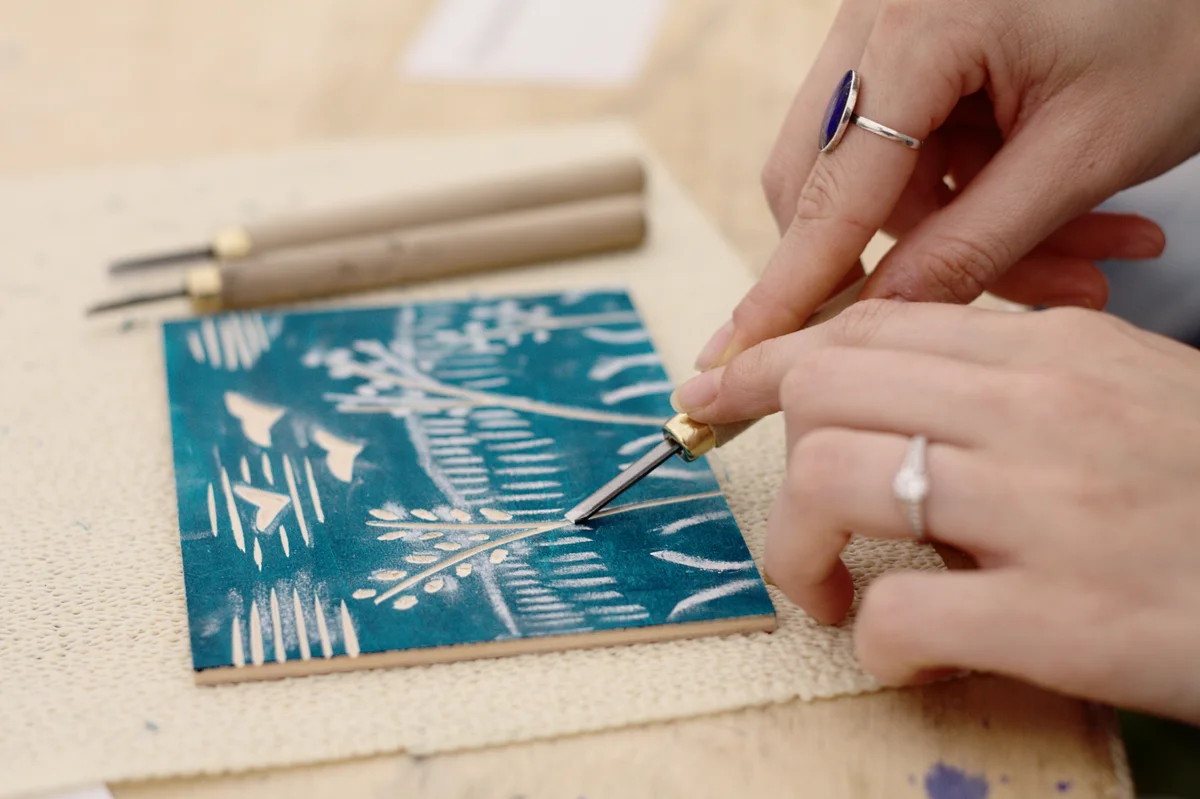 Carving a design into Japanese plywood. Photo: Zephyris, CC BY-SA 3.0
Washi — Japanese Paper
Washi (和紙) is traditional Japanese paper, made from the inner bark of plants such as kozo (mulberry), gampi, and mitsumata. Washi is strong, absorbent, and flexible — qualities that make it perfect for mokuhanga. It takes water-based inks beautifully and can withstand the rubbing of a baren without tearing.
Popular types for printing include kozo washi (strong, with visible fibres), gampi (smooth and glossy), and hosho (a classic printmaking paper with a slightly textured surface). The paper must be dampened before printing so the ink transfers from block to fibre.
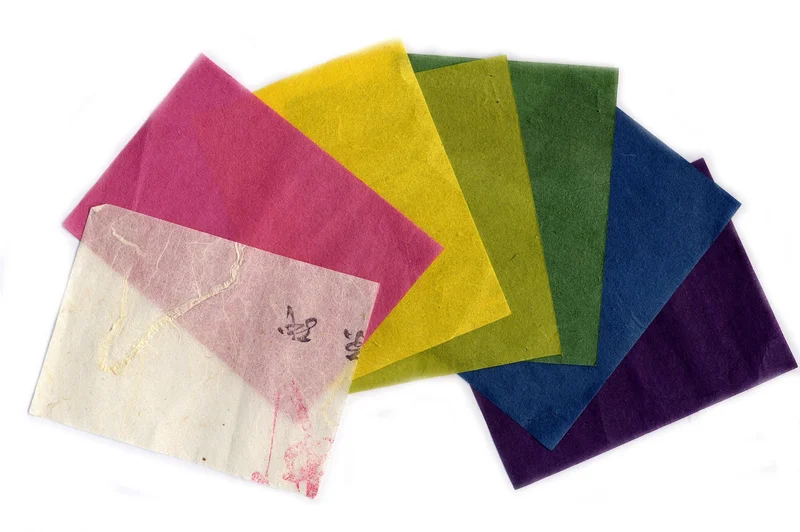 Washi paper (Sugihara paper). Photo: Tomomarusan, CC BY 2.5
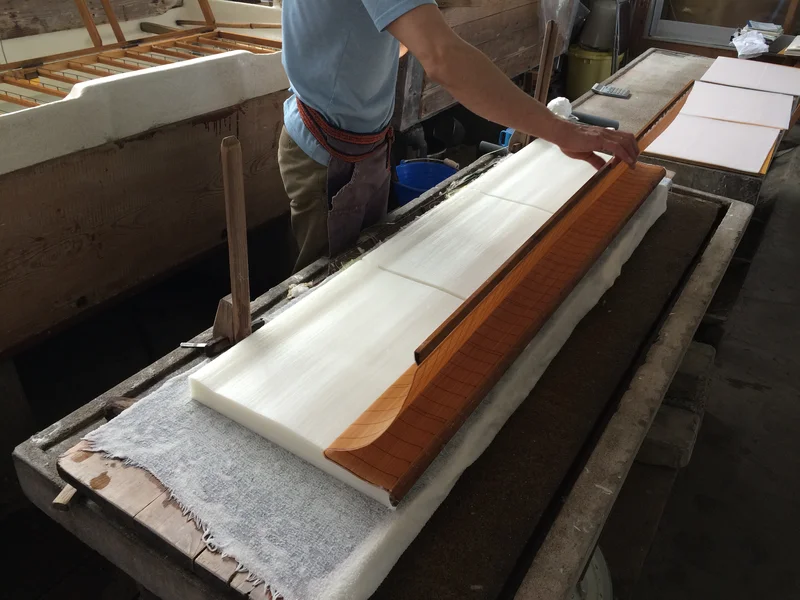 Handling a sheet of Ise washi. Photo: Nakagita Yoshiaki, CC BY-SA 4.0
Carving Tools
Japanese carving tools are quite different from Western printmaking tools. The most common are:
- Hangi-tō (版木刀) — a knife with a single-bevel blade used for outlining and cutting along the grain
- Maru-nomi (丸鑿) — a U-shaped gouge for clearing larger areas
- Komasuki-nomi (角鑿) — a V-shaped gouge for fine lines and sharp edges
- Sori-kiri (反り切り) — a curved chisel for scooping out wood
These tools are traditionally forged from high-carbon steel and require sharpening with Japanese waterstones. European equivalents can work, but the Japanese-style single-bevel blades give much more control.
Barens
The baren (馬連) is the printing tool unique to mokuhanga. Unlike Western relief printing, you don’t need a press — the baren is a flat disc with a knotted handle used to burnish the back of the paper, transferring ink from the block.
A traditional baren consists of:
- An ategawa — layers of washi paper pasted into a disc
- A shin — a coiled rope made from braided bamboo sheaths
- An outer takenokawa (bamboo sheath) wrapping
Different baren types are used for different effects — a tight coil for solid areas, a looser coil for gentle gradients. Modern alternatives include glass and ball-bearing barens.
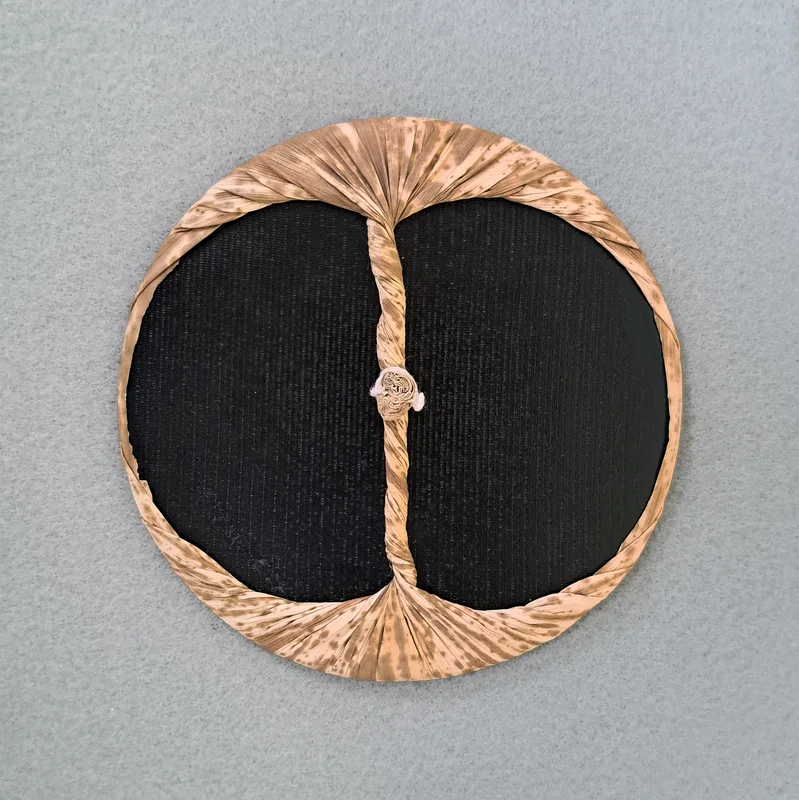 A traditional baren. Photo: Tiouraren (Y.-C. Tsai), CC BY-SA 4.0
Pigments & Inks
Mokuhanga uses water-based inks and pigments — no solvents or oils. This is what makes the technique so ecological and accessible.
- Sumi (墨) — traditional black ink made from pine soot and animal glue. Rich, deep black with a slight sheen.
- Natural pigments — mineral and plant-based pigments (such as gunjō ultramarine, shu vermillion, and toh calcium white) have been used for centuries. They are mixed with water and a small amount of nori (rice paste) to help them adhere to the block.
- Gofun (胡粉) — calcium white pigment made from ground oyster shells, used as an opaque white and as a base layer.
Modern printmakers also use watercolour pigments and water-based relief inks, which are easier to source in Europe.
Nori — Rice Paste
Nori (糊) is a rice-based paste used as a binder. A small amount is mixed into the pigment to help it transfer evenly from the block to the paper. Too much nori makes the ink sticky; too little and it won’t transfer well. Finding the right balance is part of the craft.
You can make nori from rice flour, or buy pre-made printmaking nori from Japanese suppliers.
Other Essentials
A few more items you’ll need:
- Carbon paper or kento-kiri tools for transferring your design to the block
- Kento registration marks — a corner notch and straight edge carved into the block, ensuring each colour layer aligns perfectly
- Brushes — soft brushes for applying ink and pigment to the block
- Water spray bottle — for keeping your paper damp during printing
- Baren wrap replacement — bamboo sheaths wear out and need replacing periodically